
What Helps OCD? Eight Ways to Loosen Its Grip
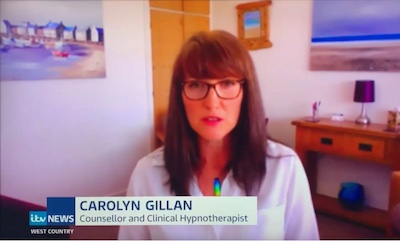
This article began with an interview I gave to ITV West Country News during the Covid lockdowns in 2021. I was asked what someone could do if they were worried that their OCD was getting worse.
The original answer became a list of eight practical suggestions. A few years on, I would explain some of them differently. My understanding of OCD has developed, and I now place much more emphasis on what your mind and body are learning from the way you respond to doubt, rather than on trying to reduce anxiety as quickly as possible.
OCD is treatable, and many people experience substantial improvement with appropriate help. But getting better does not necessarily mean reaching a point where your mind never produces another intrusive thought or uncomfortable feeling. More often, change involves thoughts carrying less authority, compulsions becoming less frequent or easier to interrupt, and more of your time and attention returning to your life.
1. Understand the pattern, not just the content
OCD can attach itself to almost anything that matters to you: harm, contamination, relationships, morality, health, identity, mistakes, bodily sensations or whether something feels “just right”. The subject matter can vary enormously, but the underlying pattern is often much more familiar.
Something triggers doubt, threat or a sense of incompleteness. Your attention narrows towards it and you feel an urge to do something that will settle the matter. You might check, avoid, ask for reassurance, search online, replay a memory, analyse your feelings or perform a mental or physical ritual. That response may bring some relief, but it can also reinforce the idea that the doubt required action.
Understanding this pattern can reduce shame and help you see where change may be possible. Good information from organisations such as OCD-UK and OCD Action can be very helpful. At the same time, more information is not always better. If you find yourself repeatedly researching OCD so that you can feel certain thatthis particular thoughtis only OCD, learning may have started to serve the same function as reassurance.
2. Learn to recognise your compulsions
Some compulsions are obvious: washing, checking a lock, repeating an action or arranging something until it feels right. Others happen almost entirely inside your head.
You might mentally review a conversation to make sure you did not say something wrong, check how you feel towards someone, compare one memory with another, test whether an intrusive thought causes the “right” emotional reaction, pray or repeat phrases to neutralise a thought, or continually ask yourself whether you are certain enough.
Reassurance can also become part of the cycle. You may ask somebody else what they think, search Google, return to an old conversation or look for evidence that your fear cannot be true. NICE specifically recognises mental rituals, neutralising strategies and reassurance seeking as relevant parts of OCD treatment.
The aim is not to monitor everything you do or compile a perfect catalogue of compulsions. It is to begin noticing the choice points where OCD says, “You need to do something about this now.”
3. Practise doing something different at the choice point
Exposure and Response Prevention (ERP) is one of the main evidence-based psychological treatments for OCD. In broad terms, it involves approaching situations, thoughts, sensations or uncertainty that OCD has taught you to fear while reducing the compulsive responses that normally follow. NICE and the NHS both recommend CBT including ERP for OCD.
ERP does not need to be an endurance test, and more distress does not automatically mean better therapy. A useful exercise is one that gives your system an opportunity to learn something different.
That might mean leaving the house after checking the door once rather than returning to it, allowing an intrusive thought to be present without analysing what it means, sending a message without rereading it repeatedly, or making a decision without continuing to compare every possible alternative afterwards.
Traditional ERP often uses graded practice, and starting with something manageable can make sense. What matters most is not whether your anxiety reaches a particular level or falls within a particular time. The more useful question is: what are you learning by responding differently?
4. Make room for uncertainty — and the feeling of responsibility
One of the hardest parts of OCD is that you may already know the feared outcome is unlikely. The problem is that unlikely does not feel good enough.
You might think, “I know the door is probably locked, but what if I don’t check and there’s a fire?”Or, “I don’t really think this ritual prevents something bad happening, but what if the one time I refuse to do it is the time something happens?”
This can create a powerful sense of responsibility. Not performing the compulsion may feel careless, reckless or even morally wrong. Sometimes there is a superstitious or magical quality to it: intellectually you know your action cannot control the future, but emotionally it can still feel as though refusing the ritual is somehow tempting fate.
Trying to prove that nothing bad will happen usually takes you back into the same search for certainty. The alternative is not to stop caring about responsibility. It is to practise making reasonable, proportionate decisions without requiring the absolute guarantee OCD is demanding.
Self-trust grows from discovering that you can choose with the information available, tolerate some uncertainty, and respond to what actually happens rather than trying to prevent every imaginable possibility.
5. Don’t make calm the requirement for moving forward
Breathing exercises, mindfulness, grounding and other forms of regulation can all be useful. What matters in OCD is the purpose they are serving.
If you take a slower breath, notice the room around you or relax your jaw because it gives you a little more capacity to make a considered choice, that can be helpful. If you feel that you must breathe in a particular way until the anxiety disappears before you can continue, the exercise can start functioning much more like a safety behaviour.
The goal is not to make yourself calm enough to live.
Within the LIBERATE Approach™, I often describe this as practising choosing while activated. You can help your system find a little more room without requiring the thought, sensation or anxiety to disappear first.
Mindfulness can be useful for the same reason. It can help you notice thoughts as events in the mind and redirect attention towards what is happening around you. It becomes less helpful if you use it repeatedly to check whether you feel better yet.
6. Be kind to yourself without reassuring yourself
People with OCD are often extremely hard on themselves. Intrusive thoughts can generate shame, and repeated compulsions can leave you frustrated that you “gave in again” despite knowing what you intended to do.
Self-criticism rarely makes the next difficult moment easier. Kindness does not mean telling yourself that everything will definitely be fine or replacing an upsetting thought with a reassuring one. It means recognising that your mind is trying very hard to protect you, even when the strategy it is using has become costly.
You can acknowledge that something feels frightening and still decide not to perform the next ritual. You can recognise that you checked more than you intended today without turning that into evidence that you have failed or returned to the beginning.
Progress is rarely perfectly linear. A difficult day can tell you something about stress, tiredness, context or what still needs practice without cancelling the learning that has already taken place.
7. Get the right support
You do not have to wait until OCD has taken over your life before asking for help. Equally, if you have lived with it for many years, that does not mean you have missed your opportunity to change.
You can speak to your GP about treatment options, and in England you can also self-refer to NHS Talking Therapies in many areas. CBT including ERP is a recommended psychological treatment, and medication — usually an SSRI — may also be considered depending on the severity of symptoms, your circumstances and preferences.
If you choose private therapy, look for someone with appropriate professional registration and genuine experience of OCD rather than assuming that any general therapist will understand the less obvious compulsions and maintaining patterns. The Professional Standards Authority accredits registers for a number of health and care professions that are not subject to statutory regulation; BACP’s register is currently PSA-accredited.
The therapeutic relationship matters too. You need to be able to talk honestly about intrusive thoughts without fearing that the therapist will judge their content at face value.
I integrate counselling, ERP and ACT-informed work with hypnosis and other experiential methods where there is a clear clinical reason to do so.
8. Put life back into the picture
My original version of this article suggested planning what you would do with all the extra free time once you were “free from OCD”. I would put that differently now.
You do not have to wait until OCD has disappeared before you begin reclaiming your time.
If you spend an hour less checking, what belongs in that hour instead? If you stop analysing your relationship while you are having dinner together, what would you rather be paying attention to? If you decide not to Google the latest health fear, where could your attention go next?
This is more than a reward for doing ERP successfully. Re-engagement is part of the learning itself. Every time you redirect attention towards a conversation, piece of work, walk, meal, hobby or ordinary task while uncertainty is still present, you give your system another experience of life continuing without OCD having to settle everything first.
The aim is not simply to become better at coping with OCD. It is to make more room for the life that OCD has been occupying.
If you would like help with OCD
I offer specialist OCD therapy in Plymouth and online across the UK. My LIBERATE Approach™ brings together counselling, ERP, ACT-informed work, hypnosis and experiential learning within an individual formulation.
The work is collaborative rather than based on a rigid protocol. We look at what is maintaining the pattern for you, what your mind and body may need to learn through experience, and how you can respond with greater flexibility without waiting for complete certainty or perfect emotional comfort.